

You don't need special equipment to begin reading auras. Most beginner methods use soft focus, a quiet room, or a willing partner. Start with short sessions, record what you notice, and treat each impression as a point for reflection rather than a fixed fact.
Step 1: Prepare Your Space, Body, and Intention
Before you learn how to read auras, set up a calm space that lets your eyes and mind settle. Aura work is often described as sensing a subtle field around the body. In spiritual practice, some people connect this field with life force, Mana, or the aka field.
Those terms belong to different traditions and shouldn't be treated as medical facts. Within our Huna-rooted approach at Auras of Osiris, we use them as respectful ways to talk about awareness, connection, and the felt sense around a person.
Choose a room with soft, even light. Turn off harsh overhead bulbs. Keep a plain wall nearby. Wear clothes that don't pull your attention away from the exercise. Sit with both feet on the floor and let your hands rest in your lap.
Take five slow breaths. On each exhale, relax your jaw and shoulders. Set one clear intention, such as, “I want to notice what is present without forcing an answer.” That sentence matters. It keeps curiosity ahead of expectation.
Keep a small notebook close. Write down the date, your mood, the lighting, and what you noticed. The word “aura” has several meanings in common use, so the reference definition of a paranormal aura can help you separate spiritual language from everyday uses of the word.
Across ten common aura-reading methods reviewed for this guide, seven mention tools, yet none gives a clear difficulty rating. That gap means you must choose a starting point by fit. Begin with the least demanding method and build from there.
Step 2: Practice Seeing Energy With Soft Focus
Soft focus is the best first drill for learning how to read auras because it asks you to notice the space around an object without staring hard. It is a visual exercise, not a test of eyesight.
Start with your own hands. Sit in front of a dark background. Rub your palms together for 15 to 20 seconds. Then hold them about eight inches apart.
Move your hands closer together, then farther apart. Notice warmth, tingling, pressure, or a sense of pull. Don't label the feeling yet. Just note where it appears and whether it changes when your hands move.
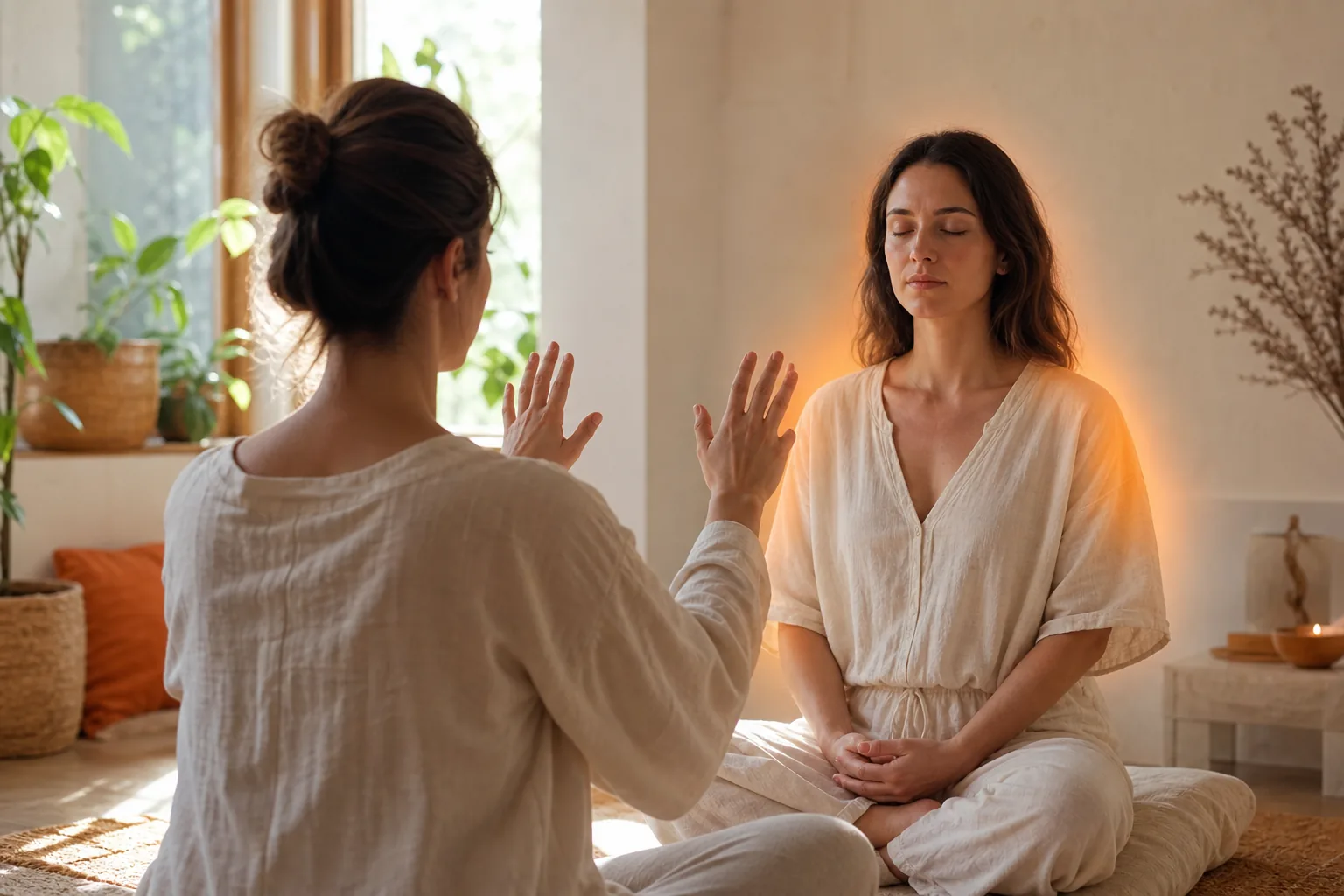
Next, place a plain light-colored wall behind a willing partner. Ask them to stand six to eight feet away. Fix your gaze on the point between their eyebrows, then soften your eyes.
Keep your attention wide for 30 to 60 seconds. Use your peripheral vision to notice the area beside the head and shoulders. You may see a pale edge, a shimmer, or a change in contrast. You may also see nothing. Both outcomes are useful.
Human vision includes a central field and a wider peripheral field. A basic overview of peripheral vision explains why this kind of exercise feels different from staring at one small point. You are asking your eyes to receive more of the scene at once.
Repeat the drill once or twice. Stop if your eyes ache or your head feels strained. The methods reviewed for this topic report typical sessions near 30 seconds when a duration is given. Short practice works better than forcing a long gaze.
If you want a gentle object to anchor the ritual, Auras of Osiris curates handcrafted crystal jewelry for meditation and personal intention. A piece such as a clear quartz bracelet can act as a touch cue, but it won't prove what you see. Your notes and steady practice remain the useful part.
Step 3: Read Your Own Aura With a Mirror
A mirror exercise lets you study your own field without needing another person. It also shows how mood, light, and focus can shape what you notice during aura reading.
Use a large mirror with a white or neutral wall behind you. Place it where the light falls evenly across your face. Avoid bright light behind your head because it can make the edge of your body hard to judge.
Stand or sit at a comfortable distance. Look at the bridge of your nose in the reflection. Soften your eyes. Keep your head still while your attention widens toward the space around your hair, neck, and shoulders.
Watch for changes in contrast before you search for color. You might notice a faint border, a hazy edge, or a shifting shape. These effects can change when you blink or adjust the light. Record the conditions beside your notes.
Try three rounds of 30 seconds. Rest your eyes between rounds. In the first round, note the outline. In the second, notice where the field seems thicker or thinner. In the third, write down any color impression that stays after you look away.
Don't decide that a color predicts your health, personality, or future. Instead, ask what the image brings to mind today. A blue impression might lead you to think about calm or clear speech. That is a personal reflection, not a diagnosis.
For ongoing self-knowledge, keep the same mirror and lighting when you can. Compare notes after a week. If the impression changes with stress or poor sleep, write that down too. Patterns are more useful than one striking session.
At Auras of Osiris, we treat aura work as a practice of reconnecting with your Higher Self. Jewelry can support that pause. It should never replace care from a qualified health professional or stand in for a clear conversation with someone you trust.
Step 4: Read Another Person's Aura With Consent
Reading another person's aura starts with consent, not technique. Ask what they are comfortable with before you begin, and agree on a stop signal.
Have your partner stand against a plain light-colored wall. Keep six to eight feet between you. Ask them to stand still and breathe normally. Don't touch them or move your hands toward their body unless they clearly agree.
Begin with soft focus at the point between the eyebrows. Let your peripheral vision take in the head and shoulders. Watch for an edge or color impression for 30 to 60 seconds.
Now try a felt-sense exercise. Hold your palm toward your partner from about two feet away. Move your hand slowly toward them. Stop before contact. Notice warmth, tingling, pressure, or a change in your own breath.
Repeat the movement once with your eyes closed only if your partner agrees. Ask what they felt before you share your own impression. That order helps prevent suggestion. It also makes the session a shared check-in rather than a performance.
Use careful language. Say, “I noticed a soft green impression near your left shoulder,” rather than, “Your aura proves you're healing.” Let your partner decide whether the image has meaning for them.
Some people like to set an intention with a wearable stone before practice. Our guide to which wrist to wear a crystal bracelet describes a reflective way to choose a side based on whether you want to receive or project an intention. Treat that choice as symbolic, not as a guaranteed energy effect.
End by asking how your partner feels. Drink water and return to ordinary conversation. If either person feels uneasy, stop at once. A respectful session is a success even when no color appears.
Step 5: Interpret Colors and Layers Without Overclaiming
Interpreting aura colors means building a personal language for impressions. It doesn't mean assigning a permanent label to yourself or anyone else.
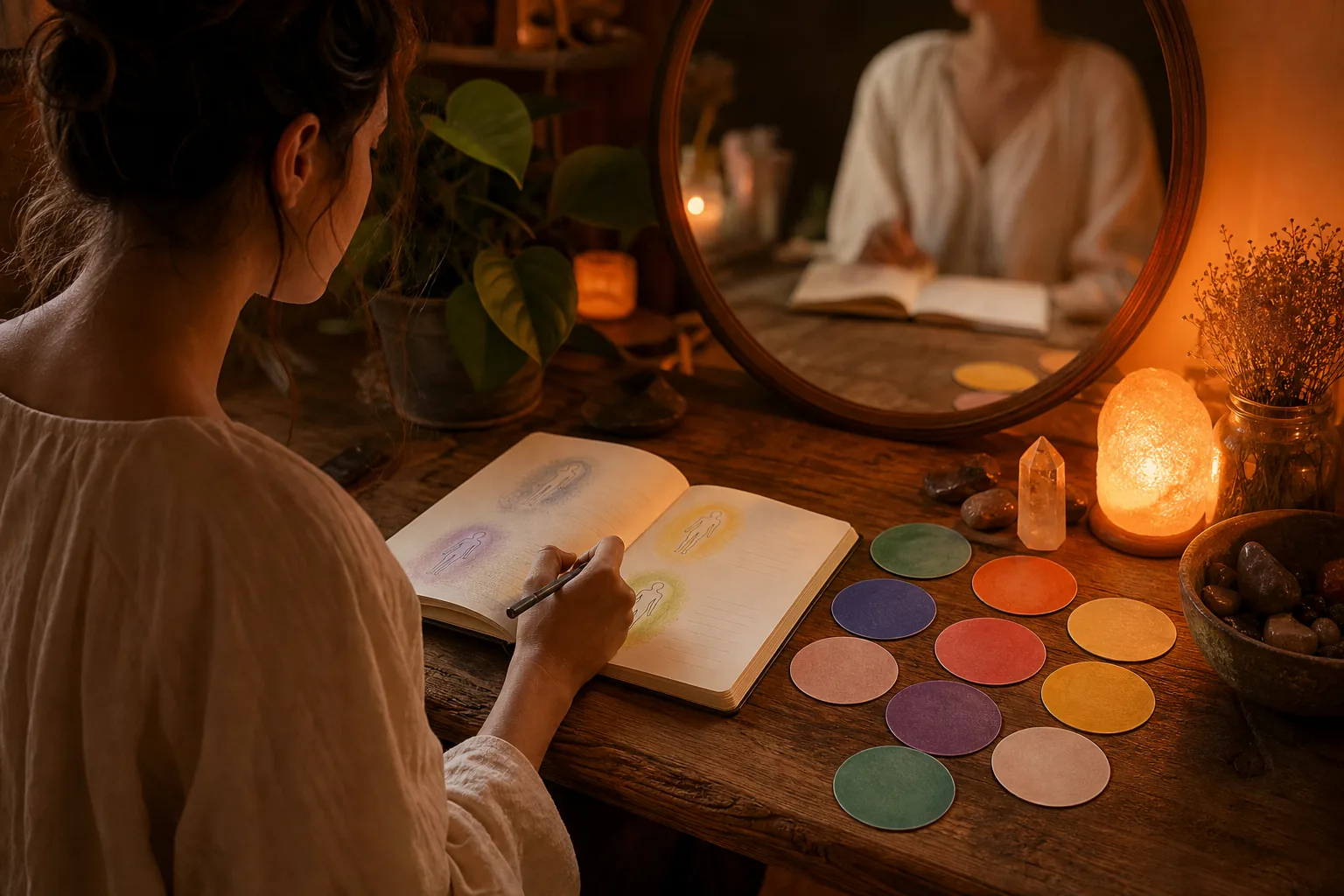
First, describe what you saw without meaning. Write “pale yellow near the right shoulder” or “a gray edge around the head.” Add the room light and your mood. This is the observation stage.
Next, ask what the color suggests to you. Yellow may bring up focus, warmth, or confidence. Green may suggest balance or renewal. Orange may feel lively, creative, or bold. These associations vary across spiritual systems, so hold them lightly.
Then look at the layer. A color close to the body may feel different from a broad haze farther out. Notice whether the impression is bright, dull, steady, or moving. Don't treat brightness as a score. It is simply another quality to record.
Use a three-column note:
- Observation: what you saw or felt.
- Context: your mood, light, and setting.
- Reflection: the meaning you choose to explore.
The word “read” can mean interpreting signs, not proving a hidden fact. This broader definition captures this wider sense of drawing meaning from what you notice.
Color afterimages deserve special care. If you stare at a bright blue circle for 30 seconds and then look at a white surface, you may see a temporary opposite color. That visual effect can teach you how the eye responds to contrast. It isn't proof of an aura.
When you want a physical reminder of your chosen intention, Auras of Osiris has handcrafted pieces described through their gemstone symbolism. Our aura cleansing crystal guide can help you compare stones for a personal ritual. Let the piece remind you to pause, breathe, and check in. Don't ask it to make promises.
FAQ
Can anyone learn how to read auras?
Yes, most people can practice aura reading as a form of visual focus and self-reflection. You don't need special gifts or costly tools. Start with a plain wall, soft light, and short sessions. Some people notice edges or colors quickly. Others develop a felt sense first. Neither path makes one person more advanced.
What is the easiest way to see an aura?
The easiest method is the soft-focus partner exercise. Ask someone to stand against a light wall six to eight feet away. Look between their eyebrows, soften your gaze, and use peripheral vision for up to a minute. Relax your eyes. If you see nothing, repeat the practice later rather than forcing an image.
What do aura colors mean?
Aura colors have symbolic meanings that vary by tradition and personal experience. Many readers link orange with vitality or creativity, green with balance, and blue with calm or expression. Treat these links as prompts for reflection. A color cannot diagnose a condition or prove what another person feels.
Can I read my own aura in a mirror?
Yes, a mirror can help you study your own aura. Stand before a neutral background, focus on the bridge of your nose, and soften your eyes. Watch the space around your head and shoulders for about 30 seconds. Keep the lighting steady, because glare and contrast can change what you see.
Do I need crystals to practice aura reading?
No, crystals aren't required to learn how to read auras. Most beginner exercises need only a wall, mirror, paper, or willing partner. A crystal bracelet may support a personal intention or remind you to pause. Use it as a symbol and grounding cue, not as proof that an impression is accurate.
Conclusion
Begin with soft focus, keep each session brief, and write down observations before assigning meaning. That steady approach gives your intuition room to grow without turning a passing image into a fixed claim. When you want a beautiful ritual piece for your practice, explore the handcrafted gemstone jewelry at Auras of Osiris, then return to your notebook and try one more calm session.